
Quick Answer: You can invest with little money by using fractional shares, ETFs, index funds, robo-advisors, and high-yield savings accounts. Many investment platforms allow beginners to start with as little as $5 to $100, making investing accessible even if you have a limited budget. The most important factors are consistency, diversification, and starting early rather than waiting until you have a large amount of money.
Many people believe investing is only for people with thousands of dollars sitting in a bank account. That belief keeps millions of people from building wealth.
The reality is very different.
Thanks to modern investing platforms, fractional shares, commission-free trading, and automated investing tools, learning how to invest with little money has never been easier. Today, beginners can start investing with as little as $5, $10, or $100 and begin building long-term wealth.
Some of the world’s most successful investors did not start with large amounts of money. They started with whatever they had available and allowed time, consistency, and compound growth to do the heavy lifting.
If you have been wondering how to invest with little money, how to start investing with $100, or whether investing for beginners is still worthwhile in 2026, this guide will walk you through everything you need to know.
You’ll learn:
- The best ways to invest with little money
- Where beginners should start
- Common mistakes to avoid
- How to invest with $100
- The best investment platforms for beginners
- How much $100 can realistically grow over time
- How to build long-term wealth even on a small budget
The goal is simple: help you make your first investment decision with confidence.
Read Also: How to Build Wealth Online: A Complete Roadmap for the Digital Generation
How We Evaluated These Investment Options
To create this guide, we reviewed beginner-friendly investment platforms, historical market performance data, investment research from major financial institutions, and publicly available educational resources.
We evaluated each investment option based on:
- Accessibility for beginners
- Minimum amount required to start
- Historical long-term growth potential
- Risk level
- Ease of use
- Diversification benefits
- Suitability for investors with $100 or less
The recommendations throughout this guide are based on established investing principles, historical market trends, and publicly available financial data from reputable sources.
Quick Verdict: Best Ways to Invest With Little Money
If you only have $100 or less to invest, here is the simplest breakdown:
| Goal | Best Option |
| Complete Beginner | Index Funds |
| Lowest Risk | High-Yield Savings Account |
| Long-Term Wealth Building | ETFs |
| Hands-Off Investing | Robo-Advisors |
| Small Weekly Contributions | Micro-Investing Apps |
| Retirement Investing | Retirement Accounts |
| Learning How Markets Work | Fractional Shares |
Overall Winner
For most beginners in 2026, broad-market ETFs and index funds remain the best starting point because they offer diversification, low fees, and long-term growth potential without requiring large amounts of capital.
Can You Really Start Investing With $100 or Less?

The short answer is yes.
In fact, many investment platforms were specifically designed for people who want to start investing with little money.
A decade ago, investing often required hundreds or even thousands of dollars. Many brokerage firms charged commissions on every trade, making small investments impractical.
That has changed dramatically.
Today, investors can buy fractional shares, meaning you can purchase a portion of a stock rather than an entire share.
For example, if a company trades at $500 per share, you don’t need $500 to invest. You can invest $25 or $50 and own a fraction of that stock.
Many brokerages now offer:
- Fractional investing
- Automated investing
- Zero-commission trading
- No minimum balance requirements
This has lowered the barrier to entry for millions of new investors worldwide.
According to data from Charles Schwab and Fidelity, fractional investing has become one of the most popular ways for younger investors to enter the stock market.
The question is no longer whether you can invest with little money. The question is where you should start.
Why Small Investments Can Lead to Significant Wealth
Many people underestimate what small investments can achieve over time. The reason is simple: compound growth rewards consistency more than large one-time investments.
For example, investing $100 today and contributing just $50 per month may not seem life-changing. However, when those investments remain in the market for years, the returns can begin generating their own returns.
Historically, diversified stock market investments have produced positive long-term growth despite short-term market volatility. While past performance does not guarantee future results, history shows that investors who start early and remain consistent often outperform those who wait for the “perfect time” to invest.
The key lesson is that building wealth is usually a gradual process. Small, regular investments made over many years can potentially grow into a meaningful portfolio.
How to Invest With Little Money: 7 Smart Options for Beginners
There is no single best investment for everyone.
The right choice depends on your goals, risk tolerance, timeline, and how involved you want to be in managing your money.
Here are some of the best investments for beginners who want to start with $100 or less.
1. Fractional Shares
Fractional shares allow you to buy a portion of a stock rather than an entire share.
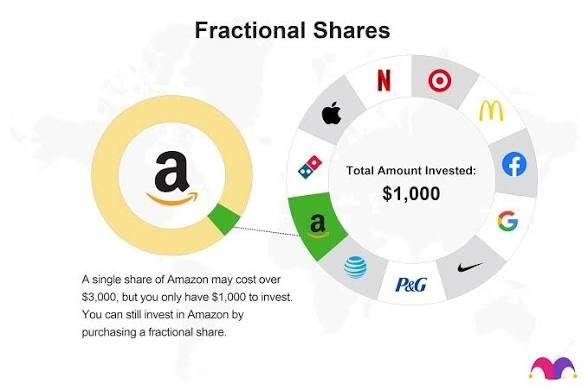
This has completely changed how beginners invest. Instead of needing hundreds or thousands of dollars to buy shares of companies like Apple, Microsoft, or Amazon, you can invest whatever amount you can afford.
Why beginners like fractional shares
- Low starting capital
- Access to large companies
- Easy diversification
- Great learning opportunity
Potential risks
- Individual stocks can be volatile
- Returns depend heavily on company performance
- Requires ongoing research
Best for
People who want to learn how stock investing works while investing small amounts.
2. Index Funds
Many financial experts consider index funds one of the best investments for beginners. An index fund tracks a group of companies rather than a single stock.
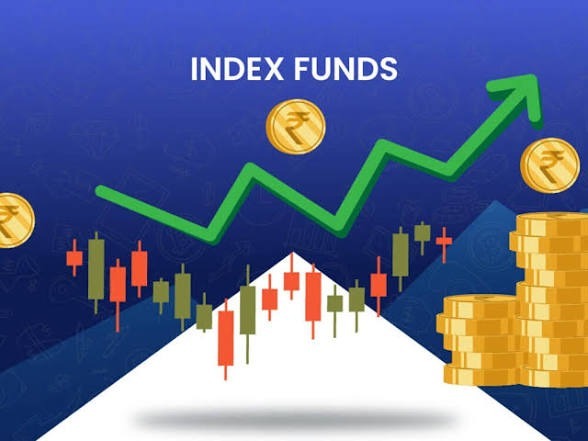
For example, an S&P 500 index fund invests in hundreds of major U.S. companies.
Instead of betting on one company, you spread your investment across many businesses.
Benefits
- Built-in diversification
- Lower risk than individual stocks
- Low management fees
- Historically strong long-term returns
Best for
People focused on long-term wealth building.
3. Exchange-Traded Funds (ETFs)
ETFs are similar to index funds but trade like stocks. They have become one of the most popular investment vehicles globally.
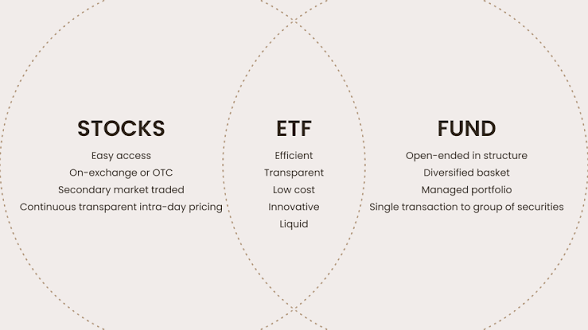
Many ETFs allow investors to gain exposure to:
- Entire stock markets
- Technology sectors
- Healthcare companies
- International markets
- Dividend-paying companies
Why ETFs are popular
- Low fees
- Easy diversification
- Beginner friendly
- Flexible buying and selling
According to BlackRock, ETFs continue to attract record investor inflows because of their simplicity and accessibility.
Best for
Investors are looking for a simple and diversified way to grow wealth.
4. High-Yield Savings Accounts
Not everyone should jump into stocks immediately. If you do not have an emergency fund, a high-yield savings account may be the smarter first step.
These accounts typically pay significantly more interest than traditional savings accounts.
Advantages
- Very low risk
- Easy access to money
- Guaranteed growth through interest
- Helps build financial stability
Best for
People are building an emergency fund before investing aggressively.
5. Robo-Advisors
Robo-advisors use algorithms to manage investments automatically.
You answer a few questions about your goals and risk tolerance, and the platform builds a portfolio for you.
Examples include:
- Betterment
- Wealthfront
- M1 Finance
Benefits
- Automated investing
- Professional portfolio management
- Low minimum investments
- Ideal for beginners
Best for
People who want a hands-off approach.
6. Micro-Investing Apps
Micro-investing apps make investing almost effortless. Many round up your everyday purchases and automatically invest the spare change.
For example:
Buy coffee for $4.50.
The app rounds up to $5 and invests the extra $0.50.
Over time, these small amounts add up.
Benefits
- Easy to start
- Encourages consistency
- Low minimum deposits
- Beginner friendly
Best for
People who struggle to save consistently.
7. Retirement Accounts
Younger investors often overlook retirement investing. However, the earlier you start, the more powerful compound growth becomes.
Retirement accounts often provide:
- Tax advantages
- Long-term growth
- Automatic contributions
- Diversified investment options
Best for
Investors focused on building wealth over decades.
See Also: How to Start Freelancing: The Complete Beginner’s Guide (2026)
Comparison of Beginner Investment Options
| Investment Type | Minimum Investment | Risk Level | Growth Potential | Best For |
| Fractional Shares | $1+ | Medium | High | Learning stock investing |
| ETFs | $5-$100 | Medium | High | Beginners |
| Index Funds | $0-$100 | Medium | High | Long-term investing |
| High-Yield Savings Account | $1+ | Low | Low-Moderate | Emergency funds |
| Robo-Advisors | $5-$100 | Medium | Moderate-High | Hands-off investing |
| Micro-Investing Apps | $1+ | Medium | Moderate | Habit building |
| Retirement Accounts | Varies | Medium | High | Long-term wealth |
Which Investment Option Is Right for You?
The best investment depends on your goals.
If You Want Long-Term Wealth
Index funds and ETFs are often the strongest starting point. They provide diversification and have historically delivered attractive long-term returns.
If You Are Nervous About Risk
Start with a high-yield savings account while building your financial confidence.
If You Want Fully Automated Investing
A robo-advisor can manage everything for you.
If You Only Have a Few Dollars
Micro-investing apps and fractional shares are excellent entry points.
If You Want To Learn Stock Investing
Fractional shares allow you to gain experience without risking large amounts of money.
How to Start Investing With $100 Step-by-Step
Learning how to start investing with $100 becomes much easier when you break the process into simple steps.
Step 1: Define Your Goal
Ask yourself:
Why am I investing?
Common goals include:
- Retirement
- Buying a home
- Building wealth
- Education expenses
- Financial independence
Your goal influences your investment choices.
Step 2: Build an Emergency Fund
Before investing heavily, aim to have emergency savings available. Many experts recommend having at least three to six months of essential expenses saved.
This prevents you from selling investments during emergencies.
Step 3: Choose an Investment Platform
Look for platforms that offer:
- Low fees
- Fractional investing
- Easy-to-use interface
- Educational resources
- Strong reputation
The simpler the platform, the easier it is to stay consistent.
Step 4: Select Your First Investment
For most beginners, diversified ETFs or index funds are a sensible starting point.
They reduce the risk of relying on one company or industry.
Step 5: Invest Consistently
Investing $25 every month often produces better results than investing $100 once and stopping.
Consistency matters.
Automation helps.
Set up recurring investments whenever possible.
Step 6: Stay Invested
Markets go up.
Markets go down.
This is normal.
Many beginner investors lose money not because they chose bad investments, but because they panic during temporary market declines.
Long-term investing rewards patience.
Read Also: Best AI Tools in 2026 to Work Smarter, Earn More, and Stay Ahead
Best Investment Platforms for Beginners in 2026
Choosing the right investment platform can make a significant difference, especially when you’re learning how to invest with little money.
The best platforms for beginners combine low fees, easy-to-use interfaces, educational resources, and low minimum investment requirements.
Best Investment Platforms for Beginners in 2026
| Platform | Best For | Pros | Cons |
| Fidelity | Beginners | No account minimums, strong education tools | Interface may feel overwhelming |
| Charles Schwab | Fractional shares | Excellent research tools | Large platform can be complex |
| Vanguard | Long-term investors | Low-cost index funds | Less beginner-friendly |
| Robinhood | New investors | Simple mobile app | Limited research tools |
| M1 Finance | Automated investing | Custom portfolio creation | Smaller educational library |
| Betterment | Robo-advising | Fully automated investing | Management fee applies |
| Wealthfront | Hands-off investing | Automated planning tools | Less flexibility for active investors |
Remember, no single platform is best for everyone. If your primary goal is learning how to invest with little money, Fidelity and Charles Schwab are often excellent starting points because they combine educational resources with low barriers to entry.
Investors focused on long-term wealth building may prefer Vanguard because of its reputation for low-cost index funds. For beginners who want a completely hands-off experience, Betterment and Wealthfront offer automated portfolio management that removes much of the complexity from investing.
The most important factor is not choosing the “perfect” platform. It is choosing a reputable platform and getting started.
For International Investors
If you live outside the United States, check whether your preferred broker is available in your country. Investors in Africa, Asia, Europe, and the Middle East may also consider region-specific investment platforms that provide access to ETFs, stocks, and retirement accounts.
Always verify fees, regulations, and account availability before opening an investment account.
What to Look for in an Investment Platform
Before opening an account, compare:
- Account minimums
- Trading fees
- Investment options
- Educational resources
- Mobile app experience
- Customer support
A beginner-friendly platform should make investing simple, not confusing.
Common Beginner Investing Mistakes to Avoid
Knowing how to invest with little money is important.
Knowing what mistakes to avoid is equally important.
Many new investors lose momentum because of avoidable errors.
Waiting Until You Have More Money
This is perhaps the most common mistake.
People often believe they need thousands of dollars before they can start investing.
The reality is that starting early with small amounts is usually more beneficial than waiting years to invest a larger sum.
Time in the market often matters more than the amount invested initially.
Chasing Investment Trends
Every year, there is a new “hot investment.”
Whether it’s meme stocks, cryptocurrency hype, or social media investment trends, many beginners buy after prices have already risen.
Successful investing usually focuses on a long-term strategy rather than short-term excitement.
Ignoring Fees
Fees may seem small initially, but they compound over time.
A portfolio paying higher management fees can lose thousands of dollars over decades compared to lower-cost alternatives.
Always understand:
- Account fees
- Trading fees
- Fund expense ratios
- Withdrawal fees
Investing Without a Goal
Investing becomes easier when you know why you’re doing it.
Clear goals help determine:
- Risk tolerance
- Investment timeline
- Asset allocation
- Contribution strategy
Investors with specific goals tend to stay more disciplined.
Panicking During Market Declines
Markets experience temporary downturns.
It happens every year.
Many beginners sell investments when prices fall, locking in losses.
Historically, markets have recovered from downturns over long periods.
Patience is one of the most valuable investing skills.
How Much Could $100 Grow Over Time?
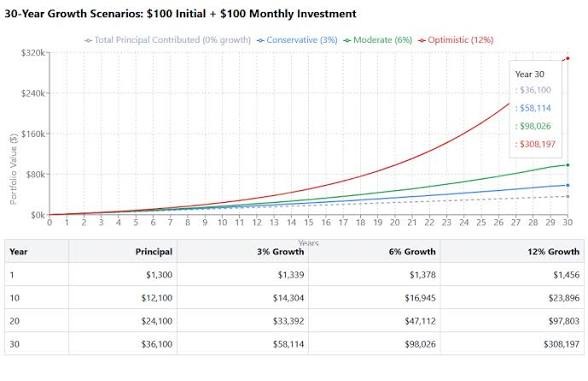
One hundred dollars alone will not create financial freedom. However, it demonstrates the power of compound growth.
The following example assumes an average annual return of 8%.
| Years Invested | Value of $100 |
| 10 Years | $216 |
| 20 Years | $466 |
| 30 Years | $1,006 |
| 40 Years | $2,172 |
Now consider what happens if you continue investing.
If you invest $100 initially and add just $50 per month, your portfolio could potentially grow into tens of thousands of dollars over several decades.
The lesson is simple:
The real power of investing comes from:
- Consistency
- Time
- Compound growth
Not from trying to find the perfect stock.
Real-World Example: Consistency Beats Timing
Consider two beginner investors:
Investor A starts investing $100 per month at age 25 and continues for 20 years.
Investor B waits until age 35 to start investing the same amount.
Assuming both earn an average annual return of 8%, Investor A is likely to accumulate significantly more wealth by retirement because their money had an extra decade to compound.
This example highlights one of the most important investing lessons: starting early often matters more than starting with a large amount of money.
Rather than waiting until you have thousands of dollars available, it is usually more beneficial to begin investing with whatever amount you can comfortably afford.
The Biggest Myth About Investing
One of the most damaging financial myths is that investing is only for wealthy people. That may have been partially true decades ago.
It is not true today.
Technology has made investing accessible to almost anyone with an internet connection and a small amount of money.
The people building wealth today are not necessarily those making huge investments.
They are often people who:
- Invest consistently
- Stay patient
- Avoid emotional decisions
- Continue learning
- Allow compound growth to work over time
Wealth is usually built gradually, not overnight.
Final Thoughts
You do not need thousands of dollars to become an investor.
Modern investment platforms have made it possible to start with as little as $5, $10, or $100. The most successful investors are not necessarily those who begin with the most money. They are often the ones who start early, invest consistently, and remain patient through market ups and downs.
For most beginners, a diversified ETF or index fund provides a simple and effective starting point. Focus on building the habit of investing regularly, continue learning, and allow compound growth to work over time.
The most important investment decision is often the first one. Starting today can make a meaningful difference to your future financial security. Subscribe to incomora.com for more insights on money building, investing, and legit wealth-architectural content.
Frequently Asked Questions
Can I invest with $100?
Yes. Many investment platforms allow beginners to start with less than $100 through fractional shares, ETFs, index funds, and automated investing accounts.
What is the best investment for beginners?
Broad-market ETFs and index funds are often considered among the best investments for beginners because they provide diversification, relatively low costs, and long-term growth potential.
Is investing $100 worth it?
Absolutely.
While $100 alone may not generate significant wealth, it helps establish investing habits and allows compound growth to begin. Small investments made consistently can become substantial over time.
How often should beginners invest?
Many financial professionals recommend investing consistently, such as weekly or monthly, rather than trying to predict market movements.
Consistency reduces emotional decision-making and helps build long-term wealth.
What is the safest way to invest with little money?
High-yield savings accounts generally carry the lowest risk. For long-term investing, diversified ETFs and index funds are often considered lower-risk options compared to investing in individual stocks.
How much can $100 grow in 10 years?
Assuming an average annual return of 8%, $100 could grow to approximately $216 over 10 years without additional contributions. Investing regularly can significantly increase that amount.
What is better for beginners: ETFs or individual stocks?
Most beginners benefit from starting with ETFs because they provide diversification across many companies. Individual stocks can offer higher returns but also involve greater risk.
Should I pay off debt before investing?
It depends on the type of debt. High-interest debt, such as credit card balances, should usually be prioritized before investing. Lower-interest debt may allow room for investing and repayment simultaneously.
Sources referenced include:
- U.S. Securities and Exchange Commission (SEC): https://www.investor.gov
- FINRA Investor Education Foundation: https://www.finra.org/investors
- Vanguard Research: https://investor.vanguard.com
- Fidelity Investments Learning Center: https://www.fidelity.com/learning-center
- Charles Schwab Investing Education: https://www.schwab.com/learn
- S&P Dow Jones Indices: https://www.spglobal.com/spdji