

For the first time in history, learning how to build wealth online has become genuinely accessible to ordinary people. A single person with a laptop and internet connection can now build income streams that once required an office, employees, investors, and massive startup capital.
But most people never reach that point.
They jump between side hustles, chase viral trends, switch platforms every few months, and mistake movement for progress. One month, it’s dropshipping. Next, it’s crypto. Then AI tools. Then, affiliate marketing. The cycle repeats, but wealth never compounds.
The problem isn’t a lack of opportunity.
The internet has created more wealth-building opportunities than any previous generation has ever had access to.
The real problem is a lack of structure.
Building wealth online isn’t about finding one magical platform or shortcut. It’s about building a system that turns skills into income, income into assets, and assets into long-term financial freedom.
This guide breaks down that system step by step.
Whether you’re starting from zero or already earning online and trying to scale, you’ll learn how digital wealth is actually built in 2026 and why the people succeeding online are following a roadmap, not chasing random trends.
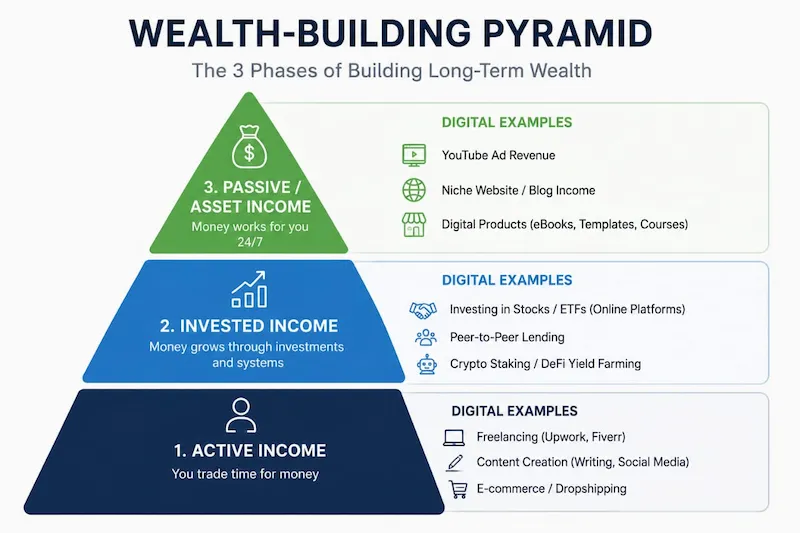
Building wealth online in 2026 follows four stages: learning a high-income digital skill, scaling that income through systems and retainers, diversifying into semi-passive income streams, and investing consistently into long-term assets. Most people fail because they chase platforms and shortcuts instead of building a structured wealth system that compounds over time.
The Digital Wealth Reality in 2026
The internet economy has matured dramatically over the past few years.
What started as “side hustles” and creator experiments has evolved into a legitimate global economy built around digital skills, online audiences, and scalable internet-based assets.
The creator economy alone is projected toward the half-trillion-dollar range globally, while remote service businesses, AI-assisted freelancing, online education, and subscription-based content models continue growing rapidly.
At the same time, traditional career paths are becoming less predictable:
- Remote work is now normalised across many industries
- AI tools are increasing productivity, but also raising competition
- Companies are outsourcing specialised work globally
- More professionals are building independent income streams outside traditional employment
According to research from:
The fastest-growing online opportunities are now concentrated around:
- AI-assisted services
- creator-led businesses
- digital products
- remote consulting
- subscription content
- online education
- niche software tools
But here’s the important part.
The people succeeding online are rarely doing random things. Most are following a repeatable sequence that answers how to build wealth online systematically
- Learn a valuable digital skill
- Monetise that skill quickly
- Scale income through systems and recurring revenue
- Convert earned income into assets and investments
- Compound over time
That’s the framework this roadmap is built around.
Read Also: The State of AI in 2026: What’s Changing and What It Means for You
The Four-Phase Digital Wealth Roadmap
Building wealth online follows a predictable sequence. Most people skip phases and wonder why nothing sticks.
| Phase | Focus | Goal | Timeline |
|---|---|---|---|
| Phase 1 | Build an income skill | Earn your first $1,000/month online | 0–6 months |
| Phase 2 | Scale and systemize | Grow to $3,000–$10,000/month | 6–18 months |
| Phase 3 | Diversify income streams | Add passive and semi-passive income | 12–36 months |
| Phase 4 | Invest and compound | Build assets that grow without your time | 24 months+ |
Each phase builds on the last. You can’t skip to Phase 4 without the foundation of Phase 1.
Phase 1: Build an Income Skill (Months 0–6)
The starting point for almost every successful online earner is the same: a skill someone will pay for.
Not an app. Not a system. A skill.
Further Reading: How to Start Freelancing: The Proven Beginner’s Guide, 2026
Here’s why: skills are the only asset that can’t be taken from you, don’t require upfront capital, and can begin generating income within weeks. This is the most overlooked part of how to build wealth online; beginners want systems before they have skills.
The Highest-Paying Digital Skills in 2026:
| Skill | Entry-Level Rate | Expert Rate | Time to First Client |
|---|---|---|---|
| AI Automation & Prompt Engineering | $50–80/hr | $130–220/hr | 2–4 weeks |
| Web Development | $35–65/hr | $120–200/hr | 4–8 weeks |
| SEO & Content Strategy | $30–60/hr | $100–180/hr | 2–6 weeks |
| Copywriting & Content Writing | $25–45/hr | $100–200/hr | 2–4 weeks |
| Digital Marketing & Paid Ads | $30–60/hr | $110–200/hr | 3–6 weeks |
| Video Editing | $30–55/hr | $100–200/hr | 2–4 weeks |
| Graphic Design | $25–50/hr | $100–180/hr | 3–6 weeks |
| Virtual Assistance | $15–25/hr | $50–80/hr | 1–2 weeks |
Pro Tip – Don’t just pick the highest-paying skill; pick the skill that sits at the intersection of what you’re good at, what has demand, and what you can build a portfolio for quickly. Speed to first income matters more than maximum potential in Phase 1.
How to Monetise a Skill Fast:
- Create 2–3 portfolio samples – paid or unpaid, it doesn’t matter. Proof of skill is what clients buy.
- Create profiles on Upwork and Fiverr – these platforms have built-in demand. You’re not building an audience, you’re tapping into an existing one.
- Send 5–10 personalised proposals per day – volume with specificity beats generic applications every time.
- Land your first client at a lower rate – not because your time isn’t worth more, but because reviews are your most valuable early asset. Three strong reviews unlock a completely different client tier.
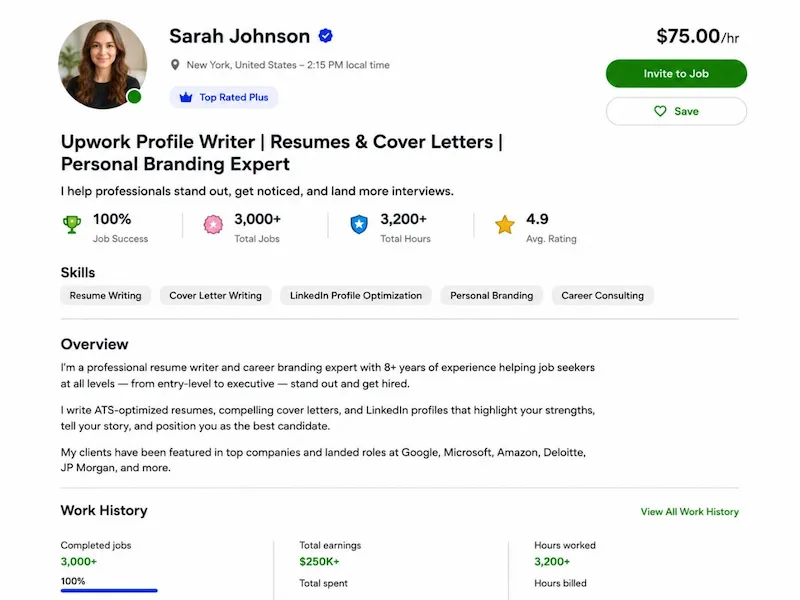
Example of a Top Rated Plus Upwork profile with a clear niche, strong headline, and verified earnings—exactly what clients look for when hiring
Your Phase 1 milestone: $1,000/month in consistent, repeatable client income. Don’t move to Phase 2 until you hit this. Consistency matters more than peak earnings.
Phase 2: Scale and Systemise (Months 6–18)
Once you’re earning consistently, the temptation is to work more hours. Don’t. The people who get stuck in Phase 1 forever trade hours for dollars indefinitely. The move in Phase 2 is to trade systems for dollars.
Three Ways to Scale Without Working More:
1. Raise your rates aggressively.
Most freelancers undercharge. After every 10 completed projects, increase your rate by 15–20%. Clients who value your work will stay. Those who leave were your most demanding, lowest-paying clients, and their exit is good news, not bad.
Real Example: A freelance writer starts at $0.08/word. At month 6, they raise to $0.12/word. At month 12, $0.20/word. At month 18, $0.35/word, and with the same number of clients but 4x the income.
2. Convert one-off clients to monthly retainers.
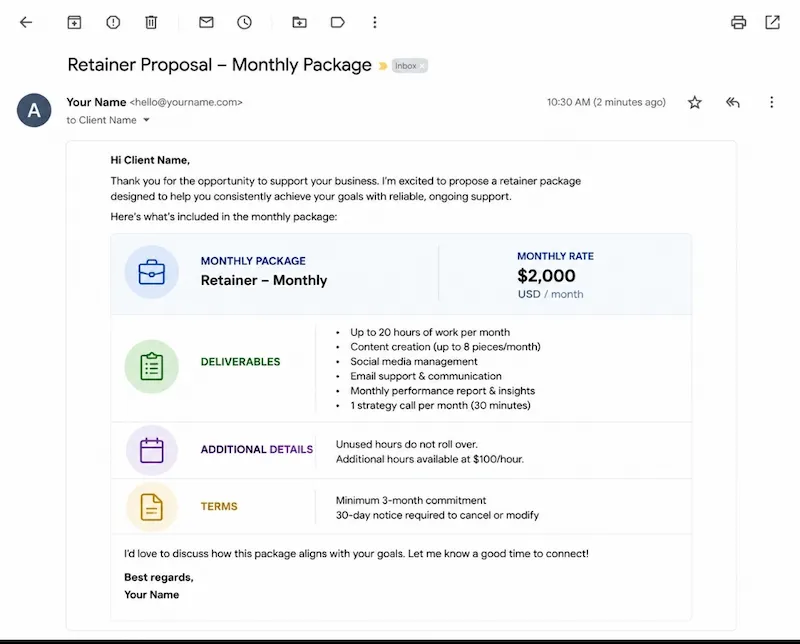
A client who paid you $400 for a one-time blog post is worth $1,600/month on a retainer. After any successful project, propose a monthly package, the same type of work, consistent delivery, and a fixed monthly invoice. Most clients who like your work will say yes.
Example of a simple retainer proposal email template.
3. Productize your service.
Turn your most common service into a fixed package with a set price, clear deliverables, and a defined timeline. This removes negotiation, attracts better clients, and makes your income more predictable. Think: “10 SEO blog posts per month, $2,500 flat” instead of “I write content, let me know what you need.”
The Revenue Milestone Targets.
| Month | Target Monthly Revenue | Key Action |
|---|---|---|
| Month 6 | $1,000–$2,000 | First 3–5 client reviews secured |
| Month 9 | $2,000–$4,000 | First retainer client signed |
| Month 12 | $3,000–$6,000 | Rates raised 20–30%, productized offer live |
| Month 18 | $5,000–$10,000 | Multiple retainer clients, referral pipeline active |
Phase 3: Diversify Your Income Streams (Months 12–36)
One income stream is fragile. One platform change, one lost client, one algorithm shift – and it’s gone. Wealth is built on diversification.
The goal in Phase 3 is to add income streams that are either semi-passive (require some maintenance but not full-time input) or fully passive (generate revenue without your daily involvement)
The Best Online Income Streams to Add in 2026:
1. Digital Products.
The right AI tools can dramatically accelerate the speed at which you build and sell digital products.
Related Reading: Best AI Tools in 2026 to Work Smarter, Earn More, and Stay Ahead
Create once, sell forever. The highest-margin business model online.
Examples:
- Templates (Notion dashboards, Canva designs, spreadsheets)
- eBooks and guides
- Online courses and workshops
- Presets, plugins, prompts
Where to sell: Gumroad, Lemon Squeezy, Teachable, your own website
Real example: A freelance SEO writer earning around $3,000/month from client work noticed that new freelancers constantly asked how she structured proposals, onboarding documents, and client communication.
Instead of repeatedly answering the same questions, she packaged her existing templates into a simple digital product:
- proposal templates
- onboarding checklists
- SEO content briefs
- client email scripts
She sold the pack for $49 through Gumroad and promoted it through LinkedIn content and her newsletter.
Within a few months, the product was generating an additional $1,500–$3,000/month with very little ongoing maintenance because the work had already been created once.
This is the power of digital assets: turning knowledge and systems you already use into scalable income.
2. Content Monetisation.
Building a content platform – blog, YouTube channel, newsletter, or social audience, takes 6–12 months before meaningful monetisation. But once it starts, it compounds.
Monetisation options:
- Display ads (Mediavine, Raptive – $25–50 RPM for quality traffic)
- Affiliate marketing (earn 5–40% commissions recommending products you already use)
- Sponsorships (brands pay for audience access in your niche)
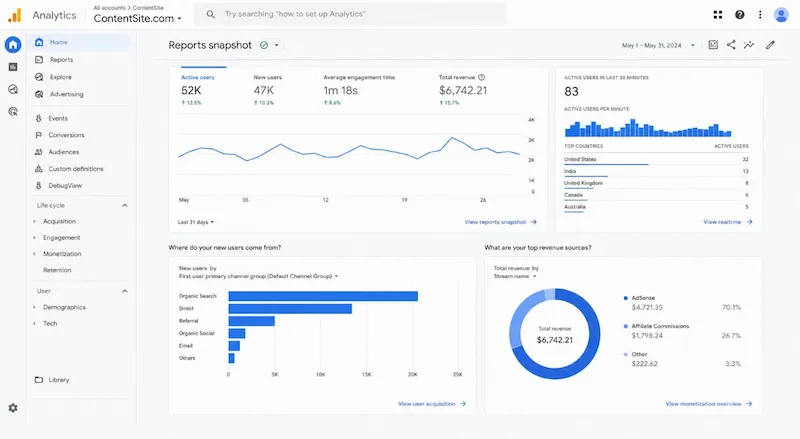
A content site generating $6,742 in monthly revenue through AdSense (70.1%) and affiliate commissions (26.7%). This is what consistent content monetisation looks like at scale.
⁕ Affiliate Marketing –
Recommend products and earn commissions when readers buy through your link—one of the most scalable semi-passive income models when attached to content.
| Affiliate Program | Commission | Best Niche |
|---|---|---|
| Amazon Associates | 1–10% | Product reviews, home, tech |
| ShareASale | Varies (avg 10–30%) | Fashion, lifestyle, B2B tools |
| Impact | Varies | SaaS, finance, travel |
| PartnerStack | 20–40% | SaaS and software tools |
| ConvertKit Affiliates | 30% recurring | Email marketing, creators |
Pro Tip: Recurring commissions from SaaS products are the most powerful source of affiliate income. A $20/month tool with 30% recurring commission pays you $6/month per customer, for as long as they stay subscribed. 100 customers = $600/month from a single affiliate relationship
3. Online Courses and Cohort Programs.
If you’ve built a real skill and real results, someone wants to learn from you. Courses and cohort programs are high-margin, scalable, and build your authority simultaneously.
Getting started:
- Start with a simple workshop ($99–$299) to validate demand before building a full course
- Use Gumroad or Teachable for hosting
- Market to your existing audience first – email list, LinkedIn, social
4. SaaS or Micro-Tools.
The highest-ceiling option, but also the hardest. Building a simple, niche tool using no-code platforms (Bubble, Glide) or with AI assistance can generate recurring subscription revenue.
This is a Phase 3–4 play, not a starting point.
Phase 4: Invest and Compound (Month 24 and Beyond)
Active and semi-passive income get you comfortable. Investing converts that income into wealth that grows without you.
The principle is simple: money you don’t invest can’t compound. Every month you delay investing is a month of compounding lost forever.
The Digital Earner’s Investment Framework.
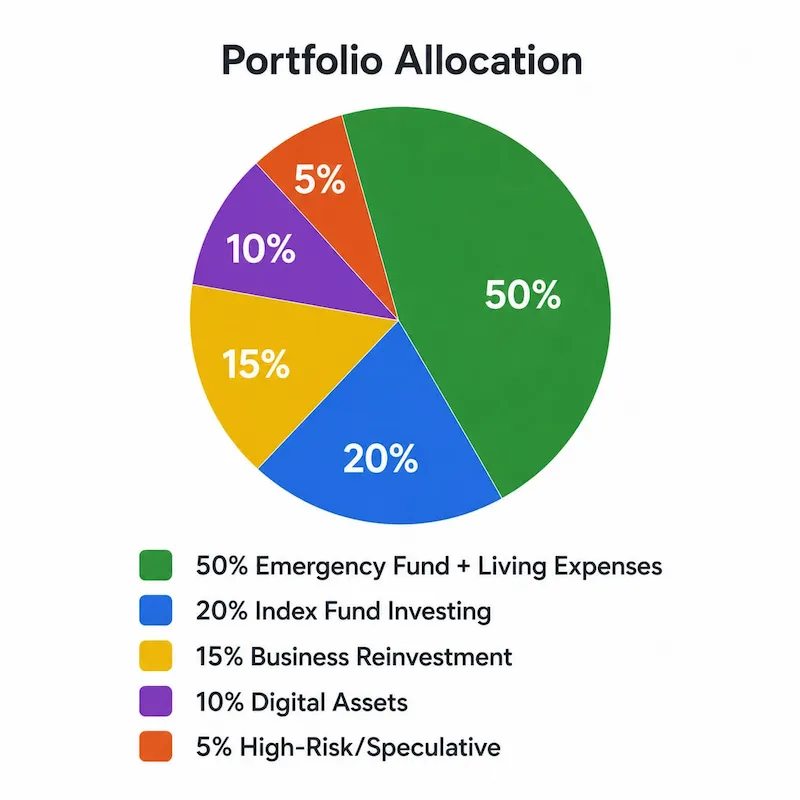
The 50/20/15/10/5 money allocation rule visualised.
Step 1: Build a 3–6 month emergency fund first.
Before any investment, you need a financial buffer. This is not optional. Without it, one slow client month sends you into panic mode, which leads to bad financial decisions.
Step 2: Open a low-cost index fund investment account.
Index funds (S&P 500 or global total market) are the single best risk-adjusted investment for most people. They require no active management, have historically returned 10% annually over the long term, and take 10 minutes per month to maintain.
Platforms available globally: Interactive Brokers, Tastytrade, Schwab (for US and international accounts).
Step 3: Reinvest in your business.
The highest-returning investment in your early years is usually your own skill and business infrastructure. Every $500 invested in a course that accelerates your freelance income by 20% pays back in weeks, not years.
Step 4: Consider digital assets selectively.
Websites, newsletters, and content businesses can be bought and sold like real estate. A blog generating $1,000/month in passive income typically sells for $30,000–$40,000 (30–40x monthly revenue). Building and flipping content businesses is a real wealth strategy in 2026 – but it requires experience first.
Step 5: Automate contributions.
Set up automatic transfers to your investment accounts the day after every client payment arrives. If the money never hits your spending account, you won’t miss it.
The Compound Effect: What Consistent Investing Looks Like.
| Monthly Investment | Annual Return | 5-Year Value | 10-Year Value | 20-Year Value |
|---|---|---|---|---|
| $200/month | 10% avg | $14,700 | $38,000 | $136,000 |
| $500/month | 10% avg | $36,800 | $95,600 | $340,000 |
| $1,000/month | 10% avg | $73,600 | $191,000 | $680,000 |
| $2,000/month | 10% avg | $147,300 | $382,000 | $1.36M |
The numbers are straightforward. The gap between the person who starts at Month 24 and the person who starts at Month 60 is not months, it’s hundreds of thousands of dollars.
The Wealth Mindset Shifts That Actually Matter
Tactics without a mindset don’t work. Here are the four mindset shifts that separate online earners who build real wealth from those who stay on the treadmill:
1. Stop trading time for money as your primary model.
A freelancer earning $8,000/month but spending every dollar immediately is financially weaker than someone earning $4,000/month while consistently building assets and investments.
Income matters. Ownership matters more.
The internet rewards people who build:
- Systems
- Digital products
- Audiences
- Invested assets
- Recurring revenue
- Time is finite. Assets are scalable.
2. Wealth is built in phases, not shortcuts.
One of the biggest traps online is believing wealth should happen instantly.
Social media compresses timelines. You see someone’s success today, but not the years of low-paying projects, failed experiments, inconsistent income, and learning curves that came before it.
The reality is much less glamorous and much more reliable.
Most successful online earners follow a progression that looks something like this:
- Year 1: Learn valuable skills and earn a consistent income
- Year 2: Raise rates, build systems, and stabilise revenue
- Year 3: Create assets and diversify income streams
- Year 4+: Invest, compound, and build ownership
That’s how sustainable online wealth is usually built.
Not through shortcuts.
Not through constant trend-hopping.
And not through chasing every new platform that appears.
The internet rewards people who stay consistent long enough for compounding to work in their favour.
3. Your income ceiling is set by your skill level, not your work hours.
The fastest way to earn more isn’t to work more, it’s to become more valuable. Every hour invested in sharpening your skill has a 10–100x return over a career.
4. Diversification is not a distraction.
Don’t diversify income streams in a year; that’s a distraction. Do diversify in Year 2+—that is wealth building. The sequence matters.
Your 90-Day Quick-Start Wealth Plan
| Week | Action |
|---|---|
| Week 1–2 | Choose your primary income skill. Build or update your portfolio with 2–3 samples. |
| Week 3–4 | Create profiles on Upwork and Fiverr. Send 5–10 proposals per day. |
| Week 5–8 | Land your first 3 paying clients. Collect reviews. Track all income. |
| Week 9–10 | Open a savings account and set aside 20% of every payment as your emergency fund seed. |
| Week 11–12 | Identify the next income stream that fits your niche — digital product, affiliate content, or course. Start building it alongside client work. |
Follow this plan, and you won’t just learn how to build wealth online; you’ll have started the process before most people finish reading about it.
Final Thoughts
Most people online spend years chasing tactics:
- New platforms
- New side hustles
- New algorithms
- New shortcuts
But wealth rarely comes from constantly restarting.
It usually comes from doing a few things consistently for a long time:
- Building valuable skills
- Increasing your income
- Creating scalable assets
- Investing the difference
- Repeating the process patiently
The internet has made wealth creation more accessible than at any point in history. But access alone changes nothing. Execution does.
You don’t need to become viral. You don’t need millions of followers. You don’t need to invent the next billion-dollar startup.
You need:
- A valuable skill
- A scalable system
- A disciplined financial habit
- A sufficient consistency for compounding to work in your favour
That’s the real online wealth roadmap in 2026.
How Long Does It Take to Build Wealth Online?
A realistic timeline to a consistent $5,000/month online income is usually 12–24 months of focused effort and skill development.
Building actual wealth, meaning investments, assets, recurring income, and financial stability, typically takes 3–5 years or more.
That’s not because online wealth is impossible. It’s because real wealth compounds gradually.
The people who succeed long term are usually the ones who:
Stay focused on one skill long enough to master it
Increase income steadily instead of chasing shortcuts
Reinvest into assets and investments consistently
Avoid constantly restarting from zero
Anyone promising overnight wealth is usually selling a fantasy, not a sustainable system.