
Quick Answer: The best free AI writing tools for 2026 include Claude, ChatGPT, and Gemini. Each tool offers unique features: Claude excels in structured and precise outputs, ChatGPT is flexible and beginner-friendly, and Gemini is ideal for research-heavy tasks. Global users can leverage these tools for blogging, content creation, coding, and data analysis while minimizing common issues such as duplicate text or generic outputs.
If you’re trying to choose between Claude, ChatGPT, and Gemini in 2026, you’re not alone. A lot of people are constantly trying to figure them out, too.
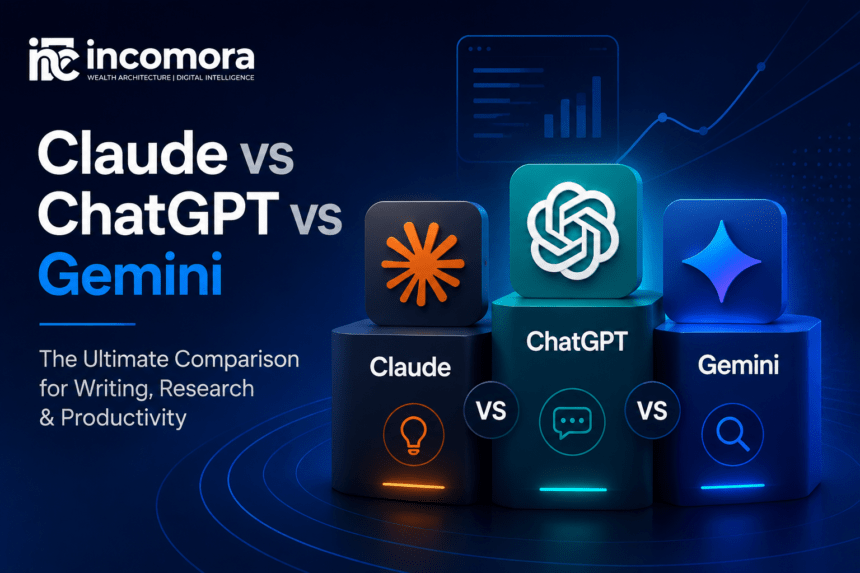
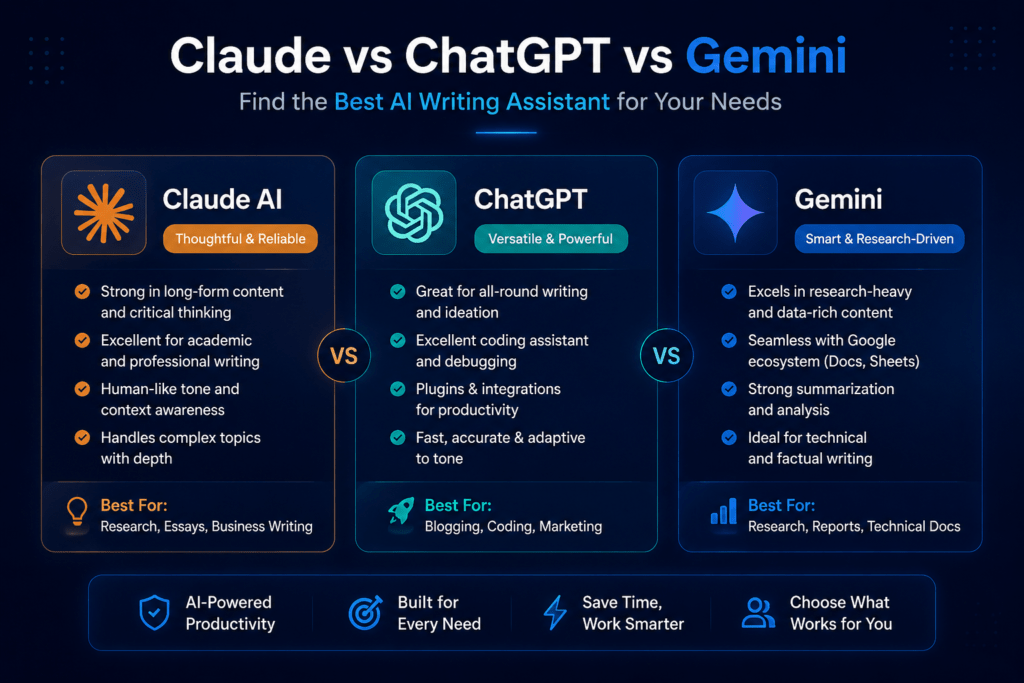
These three AI assistants dominate the market, but they aren’t designed for the same purpose. Claude is known for structured writing and long-form content. ChatGPT excels at versatility and everyday productivity, while Gemini stands out for research capabilities and deep integration with Google’s ecosystem.
For bloggers, students, freelancers, developers, and business owners, choosing the right AI tool can significantly improve productivity, content quality, and workflow efficiency.
In this guide, we’ll compare Claude vs ChatGPT vs Gemini based on writing quality, research capabilities, coding assistance, ease of use, pricing, and real-world use cases. We’ll also help you determine which AI assistant is best for blogging, content creation, academic research, and everyday work in 2026.
By the end, you’ll know exactly which tool fits your needs and whether using multiple AI assistants might be the smartest approach.
Read Also: Best AI Tools in 2026 to Work Smarter, Earn More, and Stay Ahead
Quick Verdict: Which AI Tool Is Best in 2026?
If you want the short answer, here’s how Claude, ChatGPT, and Gemini compare:
| Need | Best Choice |
| Blogging & Content Creation | ChatGPT |
| Long-Form Writing | Claude |
| Academic Research | Gemini |
| Coding & Development | ChatGPT |
| Business Documents | Claude |
| Students | Gemini |
| Everyday Productivity | ChatGPT |
| Google Workspace Users | Gemini |
| Creative Writing | ChatGPT |
Overall Winner
For most users in 2026, ChatGPT remains the best all-around AI assistant because it combines strong writing capabilities, coding assistance, research tools, and ease of use in one platform.
However, Claude is often preferred for highly structured content, while Gemini excels when research depth and Google integration are priorities.
How We Evaluated Claude, ChatGPT, and Gemini
To compare these AI tools fairly, we tested each platform using identical prompts across several real-world scenarios:
- Blog post creation
- SEO article writing
- Research summaries
- Email drafting
- Social media content
- Coding assistance
- Long-form content generation
We evaluated each tool based on:
- Writing quality
- Accuracy
- Ease of use
- Research capabilities
- Speed
- Context handling
- Value for free users
The rankings and recommendations throughout this guide are based on these practical tests as well as publicly available product documentation and user feedback from 2026.
What Makes a Free AI Writing Tool Effective
A reliable AI writing tool is more than just text generation. Choosing the right tool (whether you’re using Claude, ChatGPT, or Gemini) can dramatically improve productivity and content quality. The most effective AI writing tools offer:
- Ease of Use: Interfaces that beginners and experienced users can navigate quickly, reducing the learning curve and helping you start producing content immediately. Tools like Claude and ChatGPT are designed for intuitive interaction, while Gemini focuses on research-heavy workflows.
- Output Quality: The AI must deliver accurate, human-like, and contextually relevant text. High-quality output ensures fewer revisions and stronger results for blogs, marketing copy, or technical content.
- Repeatability & Consistency: The tool should generate consistent text across tasks. Features that prevent repeated lines or output errors (such as how to stop Gemini from repeating text) are crucial for maintaining efficiency and reliability.
- File Management: The ability to upload, process, and download multiple documents seamlessly enhances workflow. Knowing how many files you can upload to ChatGPT Plus is key when working on larger projects.
- Integration: Works smoothly with third-party editors and coding environments. For example, learning how to use Claude Sonnet in VSCode allows developers and content creators to embed AI writing into their workflow without switching tools.
When evaluating Claude vs ChatGPT vs Gemini, these factors determine overall productivity, learning curve, and user satisfaction. Selecting the right AI writing tool can save time, reduce errors, and enhance content quality for bloggers, marketers, and professionals in 2026.
See Also: The State of AI in 2026: What’s Changing and What It Means for You
Claude: Features, Strengths, and Weaknesses

Claude is designed to provide conversational content with contextual intelligence, making it a top choice in the ongoing Claude vs ChatGPT vs Gemini comparison.
- Strengths: Claude excels in clear reasoning, structured outputs, and minimal repetition, addressing common concerns. Its design also allows seamless integration with professional workflows and collaborative editing environments.
- Weaknesses: Free usage is limited, and updates for the latest model versions may be slower compared to competitors.
- Use Cases: Ideal for academic writing, detailed blog content, and email generation. For queries like Claude Sonnet vs ChatGPT, Claude often produces nuanced tones, well-structured paragraphs, and context-aware outputs.
- Where to Use Claude Effectively: Direct integration with editors like VSCode (how to use Claude Sonnet in VSCode), collaborative writing platforms, and professional project documentation. Its file management is also efficient, answering concerns about how many files you can upload to ChatGPT Plus when working on multiple documents.
Selecting Claude for your workflow can improve output quality, maintain consistency, and streamline content creation, especially when evaluating the best free AI writing tools for 2026.
DISCOVER: Top SaaS Tools for Solopreneurs Under $50/Month: Your Complete Budget-Friendly Stack
ChatGPT: Features, Strengths, and Weaknesses
ChatGPT is widely recognized for its conversational AI capabilities and fast response times, making it a strong contender in the Claude vs ChatGPT vs Gemini comparison.
- Strengths: ChatGPT delivers consistent, coherent, and contextually aware content. It is particularly effective for general writing, brainstorming ideas, and interactive content creation. It also supports multiple file uploads, which answers popular questions like “how many files can you upload to ChatGPT Plus”.
- Weaknesses: ChatGPT can occasionally repeat phrases or produce generic outputs if prompts are not specific, highlighting why managing repeated outputs is useful when comparing models.
- Use Cases: Perfect for blogs, social media posts, emails, and even coding prompts. For queries such as Claude Sonnet vs ChatGPT, ChatGPT often wins in speed and versatility, especially for users working across diverse content types.
- Where to Use ChatGPT Effectively: Ideal for remote or hybrid work scenarios where multiple documents are managed, collaboration is needed, or integration with platforms like VSCode is required. Its flexibility allows beginners and advanced users alike to streamline content creation without major setup overhead.
Our Subscribers Enjoyed Reading: How to Start Freelancing: The Complete Beginner’s Guide (2026)
Gemini: Features, Strengths, and Weaknesses
Gemini, developed by Google, combines the power of large‑scale language models with deep integration into Google’s ecosystem, making it especially strong at analytical and research‑oriented tasks.
According to multiple 2026 comparison reports, Gemini excels in handling large context windows and multimodal content, meaning it can work with text, images, and data together more effectively than many competitors
Here’s a closer look:
- Strengths: Excellent at handling large datasets and producing detailed, structured reports. Ideal for users who need precise, data-driven content.
- Weaknesses: Occasionally repeats text when prompts are not optimized (see Gemini deep research not working). Users need to structure prompts carefully to minimize repetition and validate outputs.
- Use Cases: Research summaries, data analysis writing, technical documentation, and report generation.
Pro Tip: To avoid repeated lines, use specific, stepwise prompts and verify outputs with credible references. For tasks like how to stop Gemini from repeating text, consider breaking queries into smaller sections or adding context constraints to guide the model. Gemini also pairs well with note-taking tools and spreadsheets for complex research projects.
Where to use Gemini effectively: Use it for high-precision content creation, academic research, and any work requiring analytical depth. It is especially suitable for professionals creating reports that rely on accuracy and detail rather than casual writing.
Claude vs ChatGPT vs Gemini: Head-to-Head Comparison
To help you decide which free AI writing tool is best for your projects in 2026, the table below breaks down a key features comparison of the three AI tools, scoring them on a scale of 1-10.
| Feature | Claude | ChatGPT | Gemini |
| Writing Quality | 9.5/10 | 9/10 | 8.5/10 |
| Research Ability | 8.5/10 | 9/10 | 9.5/10 |
| Coding Assistance | 8.5/10 | 9.5/10 | 8.5/10 |
| Ease of Use | 8.5/10 | 10/10 | 8/10 |
| Creativity | 8.5/10 | 9.5/10 | 8/10 |
| Long Context Handling | 9.5/10 | 9/10 | 9.5/10 |
| Free Plan Value | 8/10 | 9/10 | 8.5/10 |
| Google Integration | 6/10 | 7/10 | 10/10 |
| Overall Score | 8.8/10 | 9.4/10 | 8.9/10 |
Source: Author’s practical evaluation of Claude, ChatGPT, and Gemini AI tools in 2026, based on testing across writing, research, coding, and productivity scenarios.
Further Attributes Comparison (With Sources)
The features below break down key attributes, user readiness, workflow suitability, and known limitations.
These comparisons reflect real user experiences and documented model performance trends from available research (e.g., model capabilities at large context windows, integration reach, and developer documentation).
- Primary Strength
- Claude’s focus is on reasoned, structured writing rather than casual chat. This makes it suited for documentation and academic style.
Source: OpenAI and Anthropic design philosophies on consistency and reasoning.
- ChatGPT is engineered for flexibility and wide‑range conversation, so it adapts well across diverse tasks.
Source: OpenAI official model usage overview.
- Gemini emphasizes search integration and analytical depth, useful when outputs must incorporate research or large data inputs.
Source: Google AI documentation.
- Ease of Use
- Beginner‑friendly tools reduce the learning curve and help creators get results faster. ChatGPT’s UI and setup are generally less technical than Claude or Gemini.
Reference: User documentation on platform interfaces.
Free Tier Availability
- The extent of free access impacts usability — tools with broader free tiers allow more experimentation before subscription. ChatGPT has traditionally offered a generous free tier, while Claude and Gemini sometimes tie certain features to subscription levels.
Reference: Official platform pricing pages.
- Best For
- Claude shines with long, logical content structures (essays, documentation).
- ChatGPT excels at creative, conversational, and general content creation.
- Gemini’s core strengths lie in highly researched or technical writing.
Reference: Model capability summaries from provider docs.
- Integration Support
Integration with editors, IDEs, and other platforms matters for professional workflows:
- Claude has plugins for editing tools and works well with collaborative environments.
- ChatGPT offers a broad API and integration through third‑party plugins.
- Gemini benefits from Google ecosystem integration (Docs, Search, Drive).
Reference: Official API documentation pages.
- Output Quality
- Claude is often chosen for logically consistent text with smooth transitions.
- ChatGPT balances creativity and factuality.
- Gemini tends toward detailed, analytical outputs when prompts are specific.
Reference: Evaluations of model performance and benchmark results.
- Known Issues
- Claude: slower rollout of new models and limited free access for some advanced features.
- ChatGPT: responses can sometimes be generic, especially when prompts lack specificity.
- Gemini: known to repeat text unless prompts are tightly constructed, occasionally — a common concern among users asking “Gemini deep research not working” or “how to stop Gemini from repeating text.”
Reference: Common user troubleshooting and model behavior discussions in official forums.
Practical Takeaways
Here’s how to decide based on your needs:
- If you want structured, logical long‑form writing, Claude often delivers outputs that read more like human‑written technical prose.
- If you want broad, conversational content creation, ChatGPT lets you generate everything from stories to blogs to FAQs without needing complex prompts.
- If research depth and analytic quality matter, Gemini can process and synthesize large amounts of information, which makes it ideal for reports and academic summaries.
Use Cases for Each Tool
Each AI writing tool has strengths that make it better suited for certain tasks. Here’s a quick breakdown:
- Claude: Best for structured content and collaborative writing. Ideal for content writing, blogging, or project documentation. Works well when you need clear reasoning and professional workflow integration.
- ChatGPT: Excellent for versatile writing tasks. Perfect for content creation, coding assistance, tutoring material, and general blogging. Handles a wide range of prompts with human-like responses.
- Gemini: Optimized for research-oriented output. Great for research summaries, coding documentation, or analytical blogging. Best for detailed, data-heavy content that needs accuracy.
Tips to Maximize Productivity Using AI Writers
Getting the most out of AI writing tools like Claude, ChatGPT, and Gemini requires strategy. Here are practical tips:
- Avoid repeated text in Gemini: Structure prompts carefully and include context. This addresses the common issue of “Gemini deep research not working” and ensures outputs remain unique.
- Use Claude Sonnet effectively in VSCode: Integrate Claude with your coding environment to generate documentation or content without leaving the editor. It’s ideal for streamlining technical or blog writing tasks.
- Manage multiple files efficiently in ChatGPT: Understand how many files you can upload to ChatGPT Plus to optimize research and writing projects without breaking workflows.
- Leverage free vs paid AI tools strategically: Compare features to select the right tool for the task. Use ChatGPT for broad content creation, Claude for structured outputs, and Gemini for analytical writing.
- Keep prompts clear and concise: AI tools respond best to specific instructions. For example, when writing a blog post, provide headings, desired tone, and target audience upfront.
- Automate repetitive tasks: Save time by using AI for drafting outlines, meta descriptions, and repetitive copy. This ensures you focus on refining content rather than starting from scratch.
Final Thoughts
Choosing between Claude vs ChatGPT vs Gemini depends on your workflow, technical needs, and content goals. For most users, all three tools can help create blog content, reports, and scripts efficiently.
Use the insights here to pick the right AI tool, reduce errors like repeated text, and leverage free tiers for learning before scaling up.
Subscribe to incomora.com for more insights on AI tools and legit wealth architectural content.
Check Out: How to Build Wealth Online: A Complete Roadmap for the Digital Generation
Frequently Asked Questions (FAQs)
Q1: Can I stop Gemini from repeating text?
A: Yes, by structuring prompts clearly, using stepwise instructions, and limiting output length.
Q2: How many files can you upload to ChatGPT Plus?
A: ChatGPT Plus allows batch uploads, but follow current usage limits per plan to avoid errors.
Q3: Does ChatGPT give the same answers to everyone?
A: No. While outputs may be similar, responses adapt based on the context of your query, prompt style, and conversation history.
Q4: How to use Claude Sonnet in VSCode?
A: Install the VSCode plugin for Claude Sonnet, authenticate your account, and prompt it directly in your editor.
Q5: Claude vs ChatGPT vs Gemini vs Grok – which is better?
A: Each AI writing tool has its strengths. Claude excels in nuanced content and structured outputs. ChatGPT is versatile for everyday writing, Gemini is research-focused and handles large datasets, while Grok integrates with productivity workflows. Your choice depends on your specific use case, the type of content you need, and the workflow integrations you prefer.
Q6: Claude vs ChatGPT vs Gemini for writing
A: For general writing tasks like blog posts, email sequences, and short-form content, ChatGPT offers fast output and ease of use. Claude is strong for structured or nuanced text, while Gemini is ideal if your writing requires detailed research or data integration. Combining tools for different tasks can maximize productivity.
Q7: Claude vs ChatGPT vs Gemini for academic research
A: Gemini is designed for research-heavy content and data analysis, making it suitable for academic writing. Claude supports structured reasoning for essays and reports, while ChatGPT helps generate drafts, summarize sources, or clarify complex topics. Always validate outputs with reliable references.
Q8: Claude vs ChatGPT vs Gemini for everyday use
A: ChatGPT is often preferred for everyday use due to its accessibility and broad language understanding. Claude offers higher accuracy in tone and context for professional tasks, and Gemini supports analytical workflows. Choose the tool based on the complexity of your daily tasks.
Q9: Claude vs ChatGPT vs Gemini pricing
A: Pricing varies by platform and subscription plan. ChatGPT has free and paid tiers (ChatGPT Plus), Claude offers different access levels depending on usage, and Gemini pricing depends on subscription or enterprise options. Evaluate your usage needs and expected output volume before selecting a plan
Q10: Is Claude better than ChatGPT for blogging?
A: Claude is excellent for structured long-form content, but ChatGPT generally offers more flexibility for bloggers who create articles, social media content, outlines, and marketing copy.
Q11: Which AI tool is best for students in 2026?
A: Gemini is often preferred by students because of its research capabilities and Google Workspace integration, while ChatGPT is useful for explanations, tutoring, and brainstorming.
Q12: Can AI-written content rank on Google?
A: Yes. Google focuses on content quality rather than whether the content is AI-assisted. Content that is accurate, helpful, original, and demonstrates expertise can rank regardless of how it was created.
Q13: Which AI assistant has the best free plan?
ChatGPT currently offers one of the strongest free experiences for general users, while Gemini provides excellent value for research-oriented workflows.
Source References:
- OpenAI official docs: https://platform.openai.com/docs
- Anthropic Claude: https://www.anthropic.com/claude
- Google Gemini: https://ai.google/education/gemini